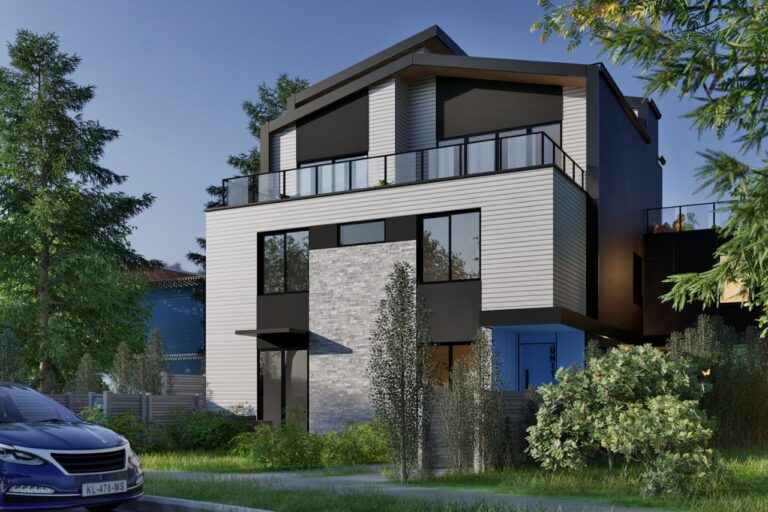


When most developers finish a duplex, triplex, or fourplex, the focus is usually on budgets, timelines, and lease-up. But in 2026, a new factor is reshaping development decisions across Ontario: evolving building regulations and the growing emphasis on missing-middle housing.
As specialists in multiplex property management for developers, we’re seeing firsthand how Ontario Building Code discussions — particularly around single-stair or single-egress buildings — are changing how multiplexes are designed, financed, and ultimately operated. Developers today are not just building units; they are building long-term operating assets.
Design has always mattered. But today, efficiency, accessibility, and long-term functionality matter just as much as aesthetics. Developers who understand how operational realities intersect with new planning trends are building properties that lease faster, retain tenants longer, and perform better financially over time.
In this article, we’ll explore how emerging building code changes and practical design decisions are shaping the future of multiplex property management for developers.
1. The Missing-Middle Opportunity
Toronto’s housing conversation has shifted significantly in recent years. Between rising construction costs and affordability pressures, developers are increasingly focused on missing-middle housing — garden suites, stacked townhomes, multiplexes, and small mid-rise buildings that bridge the gap between single-family homes and high-rise towers.
From a multiplex property management for developers perspective, this shift reflects how tenants actually want to live. Larger layouts, family-sized units, and quieter residential buildings consistently outperform smaller, high-turnover rental formats.
Traditional building code requirements have often limited usable floor area, making smaller projects harder to finance. Proposed updates that allow single-egress designs could change that equation by improving efficiency without sacrificing safety.
For developers, this means more viable projects. For multiplex property management for developers, it means buildings that operate more smoothly over the long term.
2. Single-Stair Design and Operational Efficiency
Single-stair buildings, already common in Europe and recently permitted in British Columbia, are gaining attention in Ontario because of their potential to improve building economics and accessibility.
In a single-egress design, the communal stairwell serves as both circulation and emergency egress, supported by fire-rated construction, smoke control systems, and pressurization measures designed to slow the spread of fire and smoke.
From a multiplex property management for developers standpoint, this approach has practical implications beyond construction costs. Efficient layouts often result in larger, more livable units, better natural light penetration, and less wasted corridor space.
Tenants may never think about stair configurations directly, but they immediately notice better layouts and usability. These factors contribute directly to retention, and retention remains one of the strongest drivers of long-term rental performance in multiplex property management for developers.
3. Accessibility as a Long-Term Asset
One of the most significant advantages of missing-middle housing and single-stair configurations is the ability to integrate accessibility features more easily into smaller buildings.
In traditional multiplex construction, accessibility is often limited to one unit, if any. Buildings designed with elevators and accessible layouts open the door to a broader tenant base, including seniors, mobility-challenged residents, and tenants looking to age in place.
From the perspective of multiplex property management for developers, accessibility is not simply a compliance requirement — it is a long-term operational advantage. Accessible buildings typically experience longer tenancy durations and more stable leasing demand.
Developers who incorporate accessibility early are effectively future-proofing their investments while aligning with evolving tenant demographics.
4. The Hallway Problem Still Exists
Even as building code discussions evolve, the fundamentals of tenant experience remain unchanged. We continue to see new multiplexes where cost savings are achieved by minimizing common areas, resulting in dim entryways, poor lighting, or insufficient sound separation.
In multiplex property management for developers, first impressions matter just as much in a fourplex as they do in a larger apartment building. When tenants feel uncomfortable entering a property, complaints increase and retention drops.
The operational cost of these issues often exceeds the initial savings achieved during construction. Efficiency should enhance livability, not replace it.
5. Why Property Managers Should Be Involved Earlier
Ontario’s alternative solutions process for single-egress buildings involves extensive consultation with planners, consultants, and building officials. Because approvals are reviewed on a case-by-case basis, early coordination becomes essential.
This is where multiplex property management for developers adds meaningful value before construction is complete. Property managers bring operational insight that complements architectural and development expertise.
Understanding how tenants move through buildings, where maintenance issues arise, and how layout decisions affect long-term operations allows developers to avoid costly adjustments later.
Small design decisions — such as improved mechanical access or more durable finishes — often have outsized impacts on operational efficiency once the building is occupied.
6. Building Economics and Tenant Experience Are Connected
A common misconception among developers is that building economics and tenant experience exist in opposition. In reality, they reinforce each other.
Single-stair designs aim to improve financial feasibility by increasing usable floor area. When done correctly, that efficiency translates into better layouts and more livable units, which is exactly what Toronto’s rental market increasingly demands.
From a multiplex property management for developers perspective, buildings that feel functional and comfortable attract more stable tenants. Stable tenants mean fewer vacancies, fewer disputes, and more predictable income streams over time.
Design decisions made during planning directly influence operational performance for decades.
7. Building With the End in Mind in 2026
Ontario’s housing landscape is evolving quickly. Building code discussions, financing programs, and demographic shifts are all pushing development toward mid-density housing solutions.
Developers who succeed in this environment will not simply build more units — they will build better-functioning buildings designed for long-term stability.
Multiplex property management for developers sits at the intersection of development and operations. The goal is not just to complete construction, but to create an asset that performs consistently year after year.
If you’re planning a duplex, triplex, fourplex, or missing-middle development, inviting a multiplex property management for developers specialist to review design decisions before completion can identify operational risks early and protect long-term rental income.
The difference between a building that struggles with turnover and one that generates stable income often comes down to details identified before the first tenant moves in.
Get in Touch
📞 Call: 647-294-5111
📧 Email: contact@avshospitality.ca
📲 Instagram: @avs_hospitality
▶️ YouTube: AVS Hospitality Channel
👉 Website: AVS Hospitality